
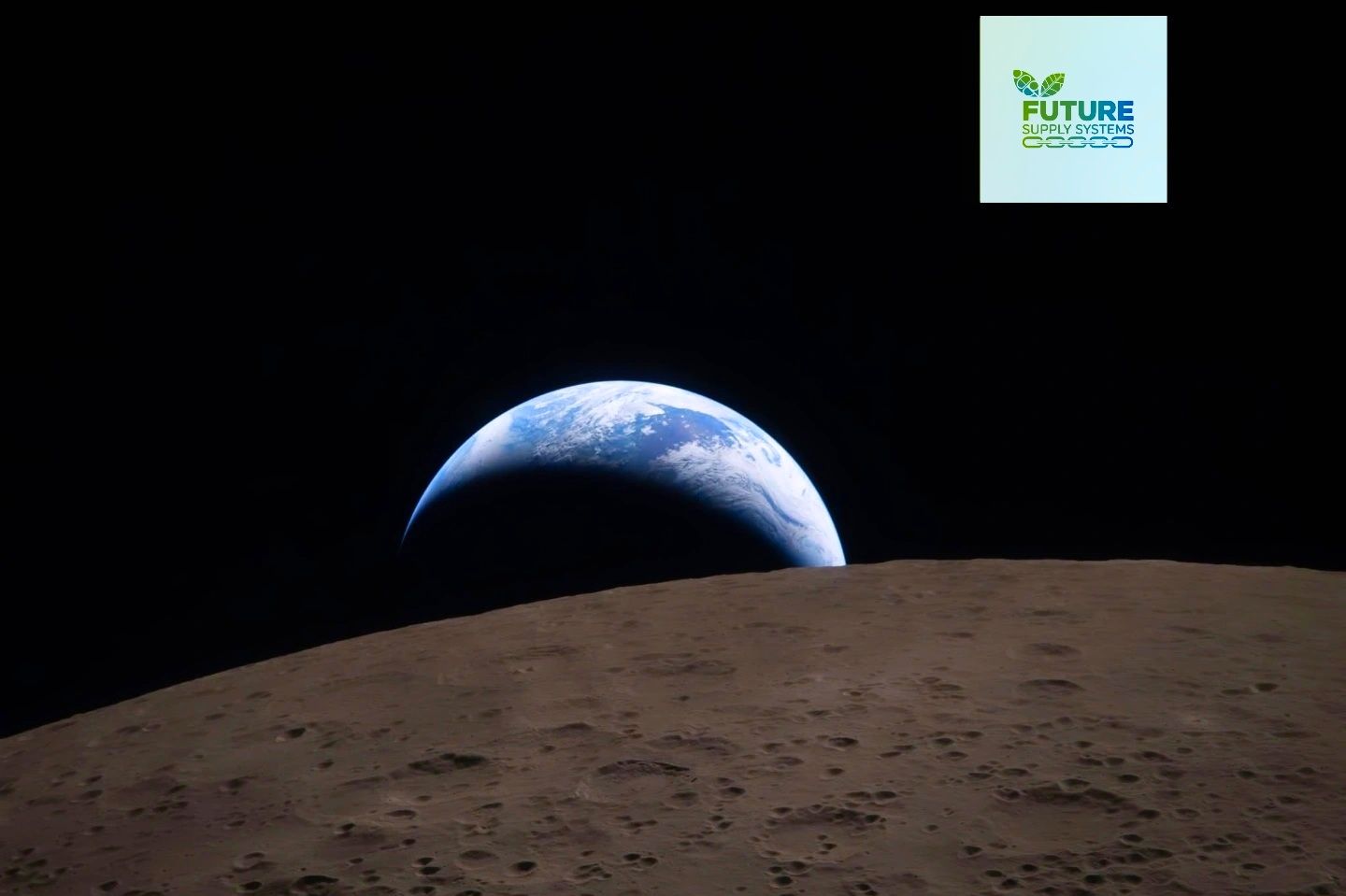
Artemis II Photo from the other side of the Moon 2026
by Future Supply Systems • June 6th, 2026
Why the Future of Logistics Extends Beyond the Planet
For generations, supply chain professionals have mastered one of humanity’s most complex challenges: moving products, materials, and information across Earth efficiently, reliably, and at scale.
From the construction of railroads and interstate highways to the development of containerized shipping, aviation networks, and digitally connected distribution systems, logistics has consistently evolved to support economic growth and human progress.
Every major advancement in civilization has been accompanied by an equally significant advancement in supply chain infrastructure.
Today, however, we stand at the threshold of a transformation unlike any before.
The next great logistics revolution will not occur across another continent, another ocean, or another transportation corridor.
It will occur beyond Earth itself.
The Emergence of the Space Economy
The global space economy is projected to exceed $1.1 trillion by 2040, positioning it as one of the most significant economic growth opportunities of the twenty-first century.
What was once dominated by government exploration programs is rapidly evolving into a commercial ecosystem supported by private investment, technological innovation, and entrepreneurial ambition.
For decades, space was viewed primarily through the lens of science, research, and national prestige.
Today, it is increasingly becoming a business environment.
Commercial launch providers are conducting more frequent missions. Private companies are developing orbital infrastructure. Governments are investing in lunar and deep-space initiatives. Research institutions are expanding their capabilities beyond Earth-based facilities.
As these activities accelerate, a reality becomes increasingly clear:
Every space mission depends on a supply chain.
Just as factories require materials, retailers require inventory, and manufacturers require transportation networks, future space operations will require robust logistics systems capable of supporting sustained activity beyond Earth’s atmosphere.
Space Logistics Is Already Here
The concept of space logistics is often discussed as though it belongs to a distant future.
In reality, it has already begun.
Every launch vehicle requires procurement, manufacturing coordination, inventory management, transportation scheduling, quality control, risk mitigation, and mission planning.
Every satellite deployment involves complex supply chain integration across multiple suppliers, technologies, and transportation systems.
Every successful launch creates additional demand for logistics expertise.
The increasing launch cadence being achieved by commercial providers is not simply a transportation achievement—it is the early formation of a new logistics ecosystem.
As launch costs continue to decline and launch frequency increases, supply chain professionals will play an increasingly important role in ensuring that critical materials, equipment, technologies, and resources arrive where they are needed, when they are needed.
The Artemis Era: Building a Supply Chain to the Moon
One of the most significant developments shaping the future of logistics is the establishment of sustained lunar operations.
The objective is no longer simply reaching the Moon.
The objective is staying there.
Long-duration lunar missions will require the same fundamental support systems that sustain operations on Earth:
– Transportation networks
– Equipment deployment
– Spare parts management
– Maintenance support
– Inventory positioning
– Fuel distribution
– Habitat construction materials
– Resource management
– Emergency contingency planning
– Continuous resupply capabilities
The challenge is that these operations will occur approximately 238,900 miles from Earth.
Unlike terrestrial supply chains, where inventory shortages can often be corrected within days or hours, lunar operations may face weeks or months between resupply opportunities.
This reality elevates logistics from a support function to a mission-critical capability.
Commercial Space Stations and Orbital Infrastructure
The growth of commercial space stations represents another major inflection point for supply chain innovation.
Future orbital facilities will require continuous operational support similar to large industrial assets on Earth.
These environments will depend upon:
– Predictive maintenance systems
– Equipment lifecycle management
– Inventory optimization
– Transportation scheduling
– Resource forecasting
– Autonomous replenishment systems
– Mission-critical risk management
Supply chains will become permanent operational requirements rather than temporary mission support functions.
The organizations that understand how to manage these complex environments may become the logistics providers of the future space economy.
Why Traditional Supply Chain Skills Matter More Than Ever
Many view space as an entirely new industry requiring entirely new expertise.
The reality is more nuanced.
The core principles that drive successful terrestrial supply chains remain remarkably relevant.
Challenges such as:
– Lead-time management
– Supplier reliability
– Capacity planning
– Demand forecasting
– Risk mitigation
– Network optimization
– Procurement strategy
– Transportation efficiency
– Operational resilience
will not disappear in space.
They will become dramatically more important.
When transportation windows are limited, launch opportunities are expensive, and delivery destinations exist hundreds of thousands—or eventually millions—of miles away, the margin for error becomes significantly smaller.
A missed shipment on Earth may create inconvenience.
A missed shipment in space may jeopardize an entire mission.
The Rise of Interplanetary Supply Chain Management
At Future Supply Systems (FSS), we believe the logistics profession must begin preparing for what we call:
Interplanetary Supply Chain Management
This emerging discipline extends traditional logistics principles into environments where transportation, communication, storage, and operational support occur across multiple celestial destinations.
Future supply chains may include:
– Earth-to-orbit transportation networks
– Orbital warehousing systems
– Lunar distribution hubs
– Space-based manufacturing inventories
– Autonomous cargo transport systems
– Resource extraction logistics
– Deep-space maintenance networks
– Interplanetary transportation corridors
While these concepts may seem futuristic today, history consistently demonstrates that supply chains evolve alongside economic opportunity.
Every new frontier eventually requires infrastructure.
Infrastructure requires logistics.
And logistics requires leadership.
Technologies That Will Shape the Future
Organizations preparing for the next generation of supply chains should pay close attention to several transformational technologies:
Artificial Intelligence and Predictive Analytics
AI-driven systems will help forecast demand, optimize transportation schedules, identify risks, and automate decision-making in highly complex operational environments.
Digital Twins
Virtual representations of assets, facilities, transportation networks, and missions will allow organizations to simulate and optimize operations before execution.
Robotics and Autonomous Systems
Autonomous logistics platforms will become essential where human intervention is costly, delayed, or impossible.
Advanced Inventory Optimization
Future systems must balance resource availability against transportation limitations and mission-critical reliability requirements.
Resilient Transportation Networks
Supply chains will require unprecedented levels of redundancy, flexibility, and risk management to support operations beyond Earth.
The Organizations That Prepare Today Will Lead Tomorrow
History provides a valuable lesson.
The companies that dominated rail transportation were not created after railroads became commonplace.
The leaders of containerized shipping were not built after globalization had matured.
The pioneers of e-commerce fulfillment did not wait until online retail reached its peak.
They prepared before the opportunity became obvious.
The same principle applies to space logistics.
Organizations that begin building expertise today in advanced supply chain management, autonomous operations, transportation optimization, and resilient logistics networks may become foundational contributors to the future space economy.
Looking Beyond the Horizon
The future supply chain professional may oversee far more than warehouses, distribution centers, and transportation fleets.
They may coordinate orbital inventory systems.
They may manage lunar resupply operations.
They may optimize transportation corridors connecting Earth, the Moon, and future destinations beyond.
What seems ambitious today may become standard practice within the careers of today’s emerging logistics leaders.
The future of logistics is no longer constrained by geography.
It is constrained only by our willingness to anticipate what comes next and prepare for it before it arrives.
The next supply chain revolution has already begun.
The only question is whether we are preparing to participate in it.
Future Supply Systems (FSS)
Building Supply Chain Intelligence for the Industries of Tomorrow.